
Kettlebell · Intermediate
Kettlebell Alternating Row
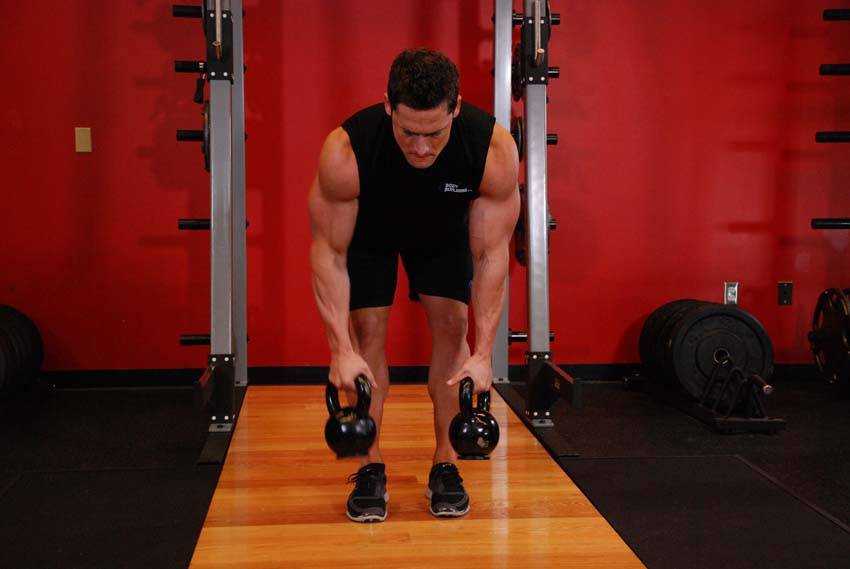
This exercise has you hinging forward at the hips and rowing one kettlebell at a time up toward your torso while the other rests on the floor. Alternating sides challenges your back muscles to work independently, which helps correct strength imbalances that build up over years of daily life. It also trains the muscles that pull your shoulders back and keep you standing tall — a direct investment in posture and upper-body function.
Category
Kettlebell
Difficulty
Intermediate
Equipment
Other
MET
9.8
Primary muscles
Secondary muscles
The movement
Form cues
- 01
Stand with feet shoulder-width apart, a kettlebell on the floor just outside each foot.
- 02
Push your hips back — not down — until your torso is roughly parallel to the floor, knees softly bent.
- 03
Grip both handles and let your arms hang straight down; this is your starting position.
- 04
Squeeze your stomach muscles like someone is about to poke you in the belly — hold that throughout.
- 05
Row one kettlebell by driving your elbow straight back toward the ceiling, not out to the side.
- 06
At the top of the pull, think about pinching a pencil between your shoulder blade and your spine.
- 07
Lower that kettlebell all the way back to the floor before lifting the other side.
- 08
Keep your hips level — resist the urge to rotate or twist your torso as you pull.
Dosage
How long, how many
Sets
3
Reps
8-12
Rest
60 sec
Watch for
Common mistakes
Rounding the lower back — if your tailbone is tucking under, push your hips further back and lift your chest slightly before you pull.
Jerking the weight up with momentum — if the kettlebell swings rather than travels in a straight line, slow down and use a lighter weight.
Flaring the elbow out to the side like a chicken wing — your elbow should travel close to your ribs, not away from your body.
Twisting the hips to help the pull — if your belt buckle is rotating left and right, you're using your whole body instead of your back muscles.
Standing up too tall — if your torso is nearly upright, you're turning this into a shrug rather than a row; hinge deeper at the hips.
Holding your breath — exhale as you pull the kettlebell up, inhale as you lower it.
Scale it
Easier and harder variations
Easier
Use a single light dumbbell and place your free hand on a bench or sturdy table for support, performing all reps on one side before switching.
Use this if balancing in the hinge position feels unstable or if lower back fatigue sets in quickly.
Harder
Pause for a full two-count at the top of each row with the shoulder blade fully squeezed before lowering.
Use this once the standard version feels controlled and you want to increase time under tension without adding weight.
Note
Sit at the edge of a sturdy chair, lean forward from the hips with a flat back, and perform the rows with a single light dumbbell — this removes all load from the lower back while keeping the pulling motion.
Use this if you have a current lower back flare-up or are returning from a back injury and need to rebuild tolerance gradually.
Sources
Form descriptions and cues are sourced from wger (CC-BY-SA 4.0) and the Free Exercise DB (public domain), edited for the 60+ audience. MET value cites Ainsworth BE, et al. 2011 Compendium of Physical Activities. Med Sci Sports Exerc 43(8):1575-1581.
- free-exercise-db · Unlicense / Public Domain
- claude