
Kettlebell · Intermediate
Kettlebell Alternating Press
You hold a kettlebell at each shoulder and press them overhead one at a time, alternating sides. While one arm pushes up, the other stays steady at your shoulder — which challenges your core and balance as much as your shoulders. This is a practical strength builder because carrying and lifting things in real life rarely happens with both arms at once. Strong shoulders also protect the joint and make everyday reaching easier.
Category
Kettlebell
Difficulty
Intermediate
Equipment
Other
MET
9.8
Primary muscles
Secondary muscles
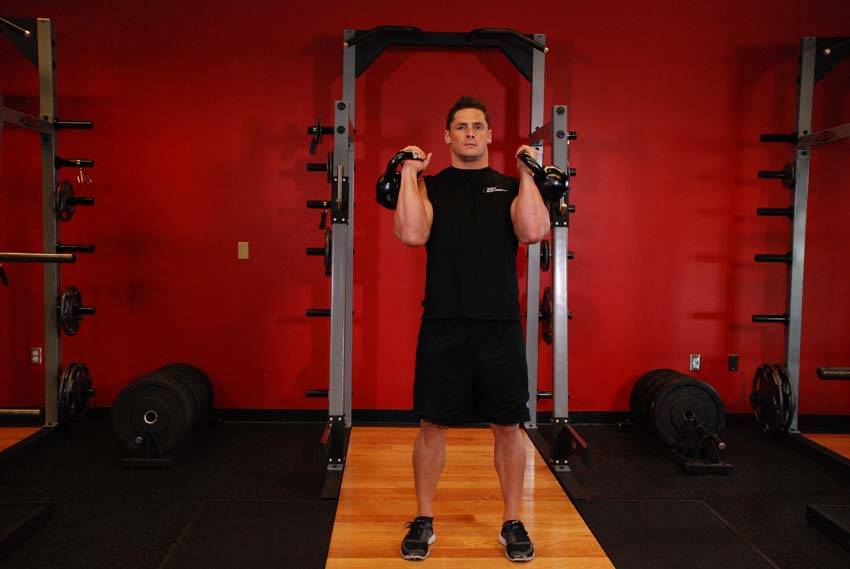
The movement
Form cues
- 01
Stand with feet shoulder-width apart, toes turned out just slightly, knees soft — not locked.
- 02
Hold one kettlebell at each shoulder with your palms facing inward and elbows pointed forward, not out to the sides.
- 03
Brace your stomach like you're about to take a light punch — this keeps your lower back from arching.
- 04
Press one kettlebell straight up, rotating your wrist so your palm faces forward at the top.
- 05
Lock your elbow out fully at the top — the bell should be directly above your shoulder, not drifting forward.
- 06
Keep the non-pressing arm rock-steady at your shoulder while the other arm works.
- 07
Lower the bell under control back to your shoulder, then immediately begin pressing the other side.
- 08
Keep your ribs down throughout — if your lower back is arching or your ribs are flaring, the weight is too heavy.
Dosage
How long, how many
Sets
3
Reps
8-12
Rest
60 sec
Watch for
Common mistakes
Leaning to the side as you press — if your torso tilts away from the working arm, the weight is too heavy or your core isn't braced.
Letting the elbow flare out wide at the start — your elbow should point mostly forward, not out like a chicken wing, or you put unnecessary stress on the shoulder joint.
Arching the lower back to get the bell overhead — if you feel your back bending backward, stop and lighten the load.
Letting the resting kettlebell drift away from the shoulder — it should stay parked at your shoulder the whole time, not hanging at your side.
Pressing the bell forward instead of straight up — at the top, your ear should be visible in front of your arm, not behind it.
Rushing the lowering phase — dropping the bell back to your shoulder instead of controlling it puts strain on the joint and wastes half the exercise.
Scale it
Easier and harder variations
Easier
Use a single light dumbbell held in both hands and press with one arm at a time, keeping the other hand lightly resting on your thigh for reference.
Use this if you're new to overhead pressing or don't yet have the shoulder stability to control two kettlebells at once.
Easier
Sit on a sturdy chair with back support and press one arm at a time — seated pressing removes the balance demand so you can focus purely on shoulder mechanics.
Good option if standing balance is a concern or if you're rebuilding shoulder strength after a long break.
Harder
Perform the press standing on one foot, switching the standing leg each set — this dramatically increases the core and balance challenge.
Try this once you can complete three sets with solid form and no torso lean.
Note
If you have a shoulder issue, swap to a neutral-grip press — keep your palm facing inward throughout the entire movement rather than rotating to face forward at the top.
The neutral grip reduces rotator cuff stress. Check with your doctor or physical therapist before pressing overhead with any shoulder injury.
Sources
Form descriptions and cues are sourced from wger (CC-BY-SA 4.0) and the Free Exercise DB (public domain), edited for the 60+ audience. MET value cites Ainsworth BE, et al. 2011 Compendium of Physical Activities. Med Sci Sports Exerc 43(8):1575-1581.
- free-exercise-db · Unlicense / Public Domain
- claude