
Kettlebell · Beginner
Kettlebell Alternating Floor Press
You lie on your back and press two kettlebells overhead one arm at a time, alternating sides. The floor limits how far your shoulders can drop, making this a safer chest press option than a bench for anyone with shoulder concerns. It builds pushing strength in your chest, shoulders, and triceps — the muscles you use every time you push yourself up from a chair or off the ground. Working one arm at a time also quietly challenges your core to stay steady.
Category
Kettlebell
Difficulty
Beginner
Equipment
Other
MET
3.5
Primary muscles
Secondary muscles
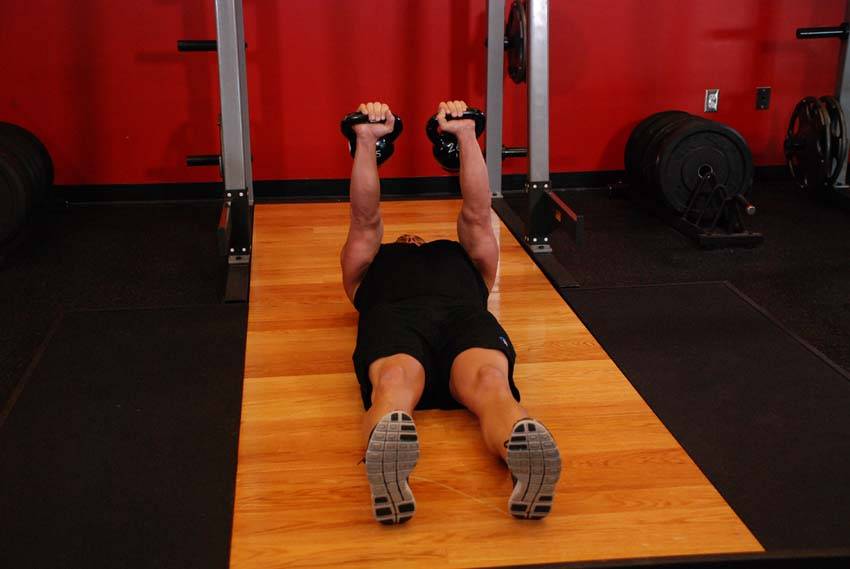
The movement
Form cues
- 01
Lie flat on your back with your knees bent and feet flat on the floor, hip-width apart.
- 02
Pick up each kettlebell and rest it on your chest before you start — don't swing them up from the floor.
- 03
Hold each handle so your palms face toward your feet, with the bell resting on the back of your wrist and forearm.
- 04
Press both kettlebells straight up until your arms are fully extended, wrists stacked directly over your shoulders.
- 05
Brace your stomach like you expect someone to tap it — keep that tension throughout the set.
- 06
Lower one kettlebell slowly toward your chest while the other arm stays locked out and steady overhead.
- 07
Stop when your upper arm touches the floor — that's your bottom position, not lower.
- 08
Press that arm back up to full extension, then repeat on the other side in a smooth, controlled rhythm.
- 09
To finish, lower both kettlebells to your chest together, then roll them to the floor — never drop them.
Dosage
How long, how many
Sets
3
Reps
8-12
Rest
60 sec
Watch for
Common mistakes
Letting the wrist bend backward — if the kettlebell is tipping back toward your face, grip tighter and keep your wrist straight and firm.
Flaring the elbow out to the side like a chicken wing — your elbow should angle about 45 degrees from your body, not 90.
Rushing through the lowering phase — if the kettlebell drops fast, you're losing the benefit and risking a shoulder strain; count two seconds down.
Holding your breath — you should exhale as you press up and inhale as you lower; if you're going silent and tense, you're probably breath-holding.
Arching your lower back off the floor — if there's a gap under your back, press your feet into the floor and tighten your stomach to flatten it.
Using a weight so heavy that the resting arm shakes or drifts — the locked-out arm should look still; if it's wobbling, go lighter.
Scale it
Easier and harder variations
Easier
Use a single light dumbbell instead of two kettlebells, pressing one arm at a time while the other hand rests on your stomach.
Good starting point if kettlebells feel awkward to position or the wrist load is uncomfortable.
Harder
Straighten your legs flat on the floor instead of keeping knees bent — this removes the leg-bracing assist and demands more core stability throughout.
Try this once you can complete 3 sets of 12 reps with steady form and no back arching.
Note
If you have a shoulder replacement or rotator cuff history, press only to the point where your elbow is level with the floor — do not lower past that point — and use a very light weight.
Check with your doctor or physical therapist before adding any pressing movement after shoulder surgery.
Sources
Form descriptions and cues are sourced from wger (CC-BY-SA 4.0) and the Free Exercise DB (public domain), edited for the 60+ audience. MET value cites Ainsworth BE, et al. 2011 Compendium of Physical Activities. Med Sci Sports Exerc 43(8):1575-1581.
- free-exercise-db · Unlicense / Public Domain
- claude