
Strength · Beginner
Goblet Squat
The goblet squat is a squat variation where you hold a single dumbbell or kettlebell in front of your chest with both hands. The weight out front acts as a natural counterbalance, making it easier to sit back into a deep, upright squat than many other versions. It builds strength in your thighs, hips, and core — all of which matter for getting up from chairs, climbing stairs, and staying steady on your feet.
Category
Strength
Difficulty
Beginner
Equipment
Dumbbell
MET
3.5
Primary muscles
Secondary muscles
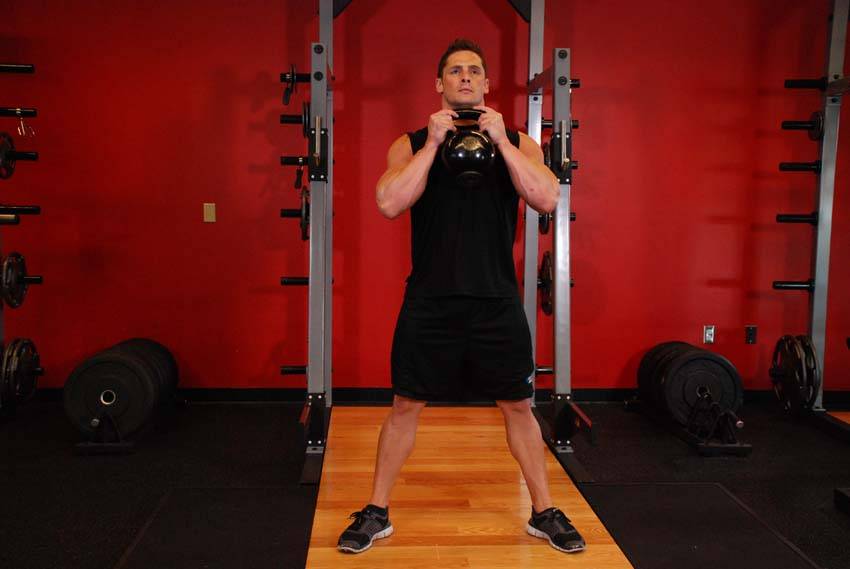
The movement
Form cues
- 01
Hold the dumbbell vertically with both hands cupped around the top end, keeping it close to your chest at chin height.
- 02
Stand with your feet shoulder-width apart and turn your toes out about 15 to 30 degrees.
- 03
Take a breath in, then squeeze your stomach muscles like someone is about to poke you in the belly.
- 04
Push your hips back and bend your knees at the same time, as if you're slowly lowering yourself onto a low chair.
- 05
Keep your chest tall and your elbows pointed down — if the dumbbell drifts away from your body, you're leaning too far forward.
- 06
Lower until your thighs are roughly parallel to the floor, or as far as feels comfortable without pain.
- 07
At the bottom, gently press your knees outward with your elbows so they track over your middle toes.
- 08
Press through your whole foot — heel and ball — to stand back up, squeezing your glutes as you reach the top.
Dosage
How long, how many
Sets
3
Reps
8-12
Rest
60 sec
Watch for
Common mistakes
Heels rising off the floor — if your heels lift as you squat down, your feet may be too close together or your ankles are tight; try widening your stance slightly or placing a thin book under each heel temporarily.
Knees collapsing inward — if your knees drift toward each other on the way down or up, actively push them apart so each knee stays over your second or third toe.
Leaning too far forward — if the weight pulls you onto your toes and your chest drops, the dumbbell is too heavy or you need to sit your hips back more before bending your knees.
Cutting the squat short out of habit — if you barely bend your knees and stand right back up, you're not loading the muscles enough to build strength; aim to feel a gentle stretch in your thighs at the bottom.
Holding your breath — if you feel your face flush or pressure build, exhale steadily as you push back up and inhale on the way down.
Scale it
Easier and harder variations
Easier
Do a bodyweight squat to a chair: stand in front of a sturdy chair, lower yourself until you just touch the seat, then stand back up. Add the dumbbell once you feel confident.
Use this if you're new to squatting, feel unsteady, or are rebuilding leg strength after a long break.
Harder
Hold a heavier dumbbell or slow the movement down — take 3 seconds to lower, pause for 2 seconds at the bottom, then stand back up.
Use this once 3 sets of 12 reps feel easy and your form is solid throughout.
Note
For sore knees, limit your depth to a quarter squat — just a few inches down — and focus on pushing your knees out. Avoid going deeper than the point where pain starts.
Use this if you have knee arthritis or recent knee discomfort. Check with your doctor or physical therapist before progressing deeper.
Sources
Form descriptions and cues are sourced from wger (CC-BY-SA 4.0) and the Free Exercise DB (public domain), edited for the 60+ audience. MET value cites Ainsworth BE, et al. 2011 Compendium of Physical Activities. Med Sci Sports Exerc 43(8):1575-1581.
- wger · CC-BY-SA 4.0
- free-exercise-db · Unlicense / Public Domain
- claude