
Cool-down · Beginner
Chest Stretch on Stability Ball
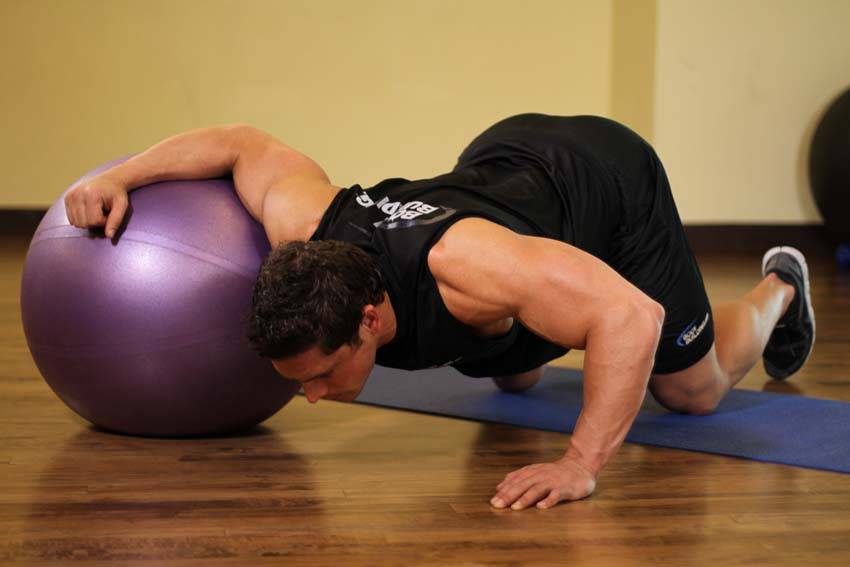
This stretch opens up the chest and the front of the shoulders by letting gravity gently do the work while your arm rests on a stability ball. Tight chest muscles are extremely common after years of sitting, driving, or working at a desk, and they can pull your shoulders forward and strain your upper back. A few minutes of this stretch can help reverse that rounding and leave you standing a little taller.
Category
Cool-down
Difficulty
Beginner
Equipment
Stability Ball
MET
2.3
Primary muscles
The movement
Form cues
- 01
Place the stability ball on a non-slip surface and kneel beside it on a folded towel or mat for knee comfort.
- 02
Rest one elbow on top of the ball with your upper arm pointing out to the side, roughly at shoulder height.
- 03
Keep your hips directly over your knees — don't sit back or lean forward.
- 04
Slowly lower your chest toward the floor, letting your shoulder drop and open as the ball supports your arm.
- 05
Stop when you feel a gentle pull across your chest and the front of your shoulder — no sharp pinching.
- 06
Breathe slowly and let your chest sink a little more with each exhale; don't force it.
- 07
Hold for 20 to 30 seconds, then carefully lift back up and switch to the other arm.
Dosage
How long, how many
Sets
2
Reps
1 hold per side
Rest
20 sec
Watch for
Common mistakes
Dropping too fast — if you sink your chest quickly you can strain the shoulder; lower yourself slowly and stop at the first sign of a deep pull.
Elbow sliding off the ball — if your arm keeps slipping, position the ball closer to your body before you start lowering.
Holding your breath — you'll notice the stretch barely works if you're tense; breathe out steadily to let the chest relax and open.
Hips drifting back toward the heels — this shifts the stretch away from the chest; keep your hips stacked directly above your knees throughout.
Forcing the stretch past comfort — a mild, spreading pull is correct; any sharp or pinching sensation in the shoulder means you've gone too far.
Scale it
Easier and harder variations
Easier
Do the stretch standing at a doorway instead: place your forearm on the door frame at shoulder height and gently lean your body through the opening.
If kneeling on the floor is uncomfortable or getting up and down is difficult.
Harder
Extend your arm straighter on the ball rather than bending at the elbow, which increases the lever length and deepens the chest and shoulder stretch.
Once the standard version feels easy and your shoulder mobility has improved.
Note
If you have a shoulder replacement or rotator cuff issue, skip this stretch and instead do a seated chest opener: sit tall, clasp your hands behind your back, and gently squeeze your shoulder blades together.
Any shoulder surgery, instability, or pain that limits overhead or outward arm movement.
Sources
Form descriptions and cues are sourced from wger (CC-BY-SA 4.0) and the Free Exercise DB (public domain), edited for the 60+ audience. MET value cites Ainsworth BE, et al. 2011 Compendium of Physical Activities. Med Sci Sports Exerc 43(8):1575-1581.
- free-exercise-db · Unlicense / Public Domain
- claude