
Cardio · Beginner
Double Leg Butt Kick
A butt kick is a quick jump where you tuck both heels up toward your backside as you leave the ground. It wakes up the quads, hamstrings, and calves all at once while giving your heart rate a gentle bump. Because the jump is straight up rather than forward or sideways, it stays manageable even if big movements feel risky right now.
Category
Cardio
Difficulty
Beginner
Equipment
Bodyweight
MET
2.8
Primary muscles
Secondary muscles
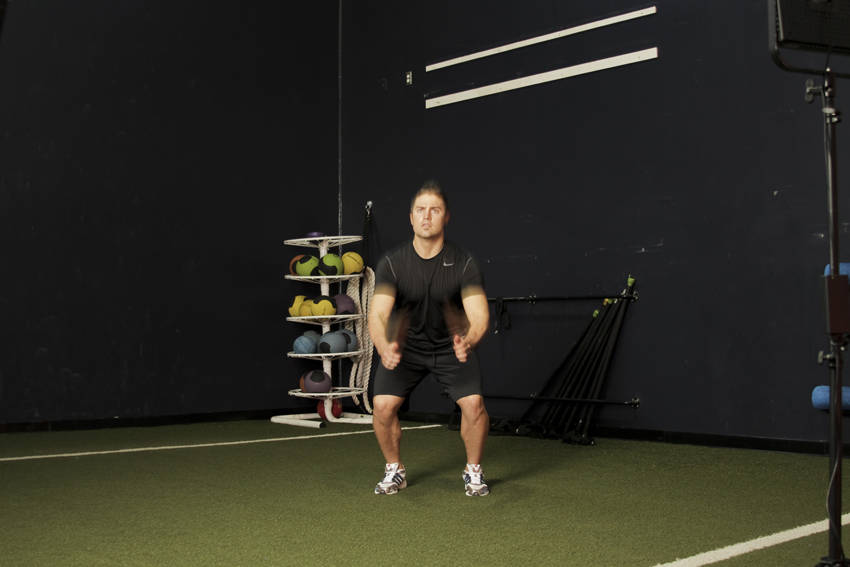
The movement
Form cues
- 01
Stand with feet shoulder-width apart and a very slight bend in your knees — never locked straight.
- 02
Drop into a shallow squat, just a few inches, before you push off — this loads your legs like a spring.
- 03
Push straight down through both feet at the same time to launch yourself upward.
- 04
As your feet leave the floor, bend both knees and pull your heels up toward your backside.
- 05
Keep your upper body tall and your arms relaxed at your sides — resist the urge to hunch forward.
- 06
Land on the balls of your feet first, then let your heels come down softly.
- 07
Bend your knees as you land to cushion the impact — think of your legs as shock absorbers, not stilts.
- 08
Pause for a full breath between jumps until the movement feels controlled and comfortable.
Dosage
How long, how many
Sets
3
Reps
8-12
Rest
60 sec
Watch for
Common mistakes
Landing with straight, stiff legs — if your knees are locked on touchdown, you're sending the impact straight into your joints; bend them to absorb it.
Leaning forward at the waist — if your chest is tipping toward the floor, you're off-balance; keep your torso upright throughout.
Only one heel coming up — if your heels aren't reaching equally, slow down and focus on pulling both knees up together.
Jumping too high before you're ready — a bigger jump means a harder landing; start with just a few inches of air until the landing feels smooth.
Holding your breath — if you notice you're tensing up and not breathing, exhale on the jump and inhale on the landing.
Scale it
Easier and harder variations
Easier
Skip the jump entirely: stand in place and alternate lifting one heel at a time toward your backside in a quick marching rhythm.
Use this if jumping feels too jarring, if you have joint pain, or if you want to learn the heel-tuck motion before adding impact.
Harder
Add a small pause at the top of each jump, really pulling your heels as close to your backside as possible before landing.
Try this once your landings feel consistently soft and controlled.
Note
Hold the back of a sturdy chair with both hands and do the no-jump marching version, focusing on the heel-tuck motion without any impact.
Use this if you have knee replacement, hip concerns, or balance issues that make unsupported jumping unsafe right now.
Sources
Form descriptions and cues are sourced from wger (CC-BY-SA 4.0) and the Free Exercise DB (public domain), edited for the 60+ audience. MET value cites Ainsworth BE, et al. 2011 Compendium of Physical Activities. Med Sci Sports Exerc 43(8):1575-1581.
- free-exercise-db · Unlicense / Public Domain
- claude