
Cardio · Beginner
Chest Push Single Response
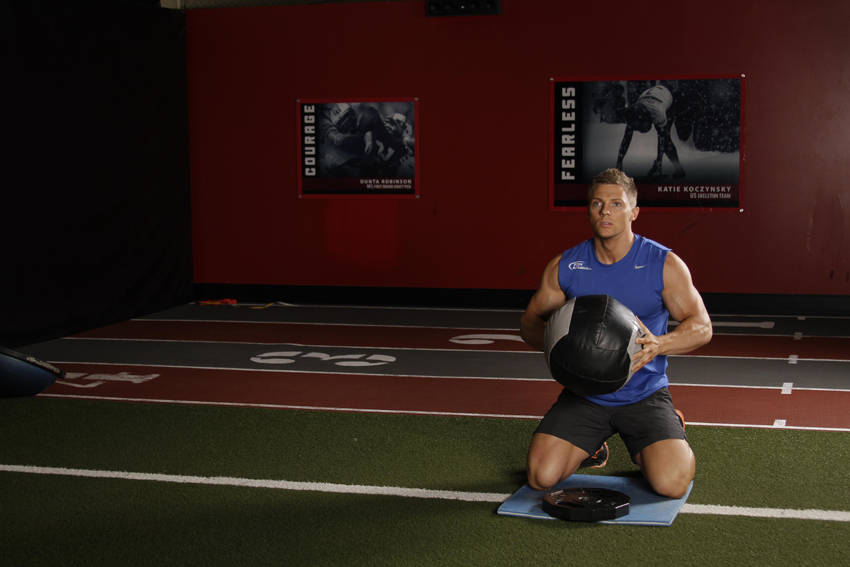
This is a kneeling medicine ball throw where you explode the ball away from your chest with as much force as you can generate in one burst. It trains your chest, shoulders, and core to produce power quickly — the same kind of quick-reaction strength that helps you catch yourself if you trip or push open a heavy door. Because you're kneeling, your lower body stays out of the equation and the focus stays entirely on your upper body. The 'single response' part just means you give it one full effort rather than a rapid series of throws.
Category
Cardio
Difficulty
Beginner
Equipment
Medicine Ball
MET
2.8
Primary muscles
Secondary muscles
The movement
Form cues
- 01
Kneel on a padded surface — a folded mat or carpet works well — with your knees about hip-width apart.
- 02
Hold the medicine ball with both hands pressed firmly against the center of your chest, elbows pointing down and in.
- 03
Sit tall through your spine; don't let your lower back arch or your hips sag toward your heels.
- 04
Take a breath in, then as you exhale, drive your hips forward and simultaneously shove the ball away from your chest as hard as you can.
- 05
Push through your palms fully so your arms are nearly straight at the moment of release — don't let go early.
- 06
As the ball leaves your hands, let your body fall forward naturally and catch yourself with both hands on the floor.
- 07
Land with soft, bent elbows — think of it as a slow push-up catch, not a stiff-arm slam.
- 08
Pause, reset to the tall kneeling position, and retrieve the ball before the next rep.
Dosage
How long, how many
Sets
3
Reps
6-8
Rest
90 sec
Watch for
Common mistakes
Releasing the ball too early — if the ball pops up instead of flying straight out, you let go before your arms were fully extended. Focus on pushing all the way through until your elbows are almost locked.
Hips staying back on the heels — if your torso barely moves forward, you're not using your hips. Drive them forward as you push, like you're trying to stand up from the kneel.
Catching yourself with locked elbows — stiff arms on the floor catch can jar your wrists and shoulders. Bend your elbows as you land to absorb the impact gently.
Holding your breath through the whole movement — you'll feel a rush of tension in your head and neck. Exhale sharply as you throw; it helps you produce more force and keeps your core tight.
Using a ball that's too heavy — if your push feels slow and grinding rather than explosive, drop to a lighter ball. This exercise is about speed and snap, not grinding through weight.
Scale it
Easier and harder variations
Easier
Sit in a sturdy chair and throw the ball against a wall or to a partner instead of falling forward. This removes the floor-catch entirely.
Use this if kneeling on the floor is uncomfortable or if getting up and down from the floor is difficult.
Harder
Use a heavier medicine ball (4–6 kg) and focus on maximizing distance with each throw.
Once the movement feels smooth and controlled and the floor catch no longer feels challenging.
Note
If you have wrist, shoulder, or elbow issues, do a seated chest pass to a wall and skip the forward fall entirely — no floor contact needed.
Any time the floor-catch landing puts stress on an injured or sensitive upper-body joint.
Sources
Form descriptions and cues are sourced from wger (CC-BY-SA 4.0) and the Free Exercise DB (public domain), edited for the 60+ audience. MET value cites Ainsworth BE, et al. 2011 Compendium of Physical Activities. Med Sci Sports Exerc 43(8):1575-1581.
- free-exercise-db · Unlicense / Public Domain
- claude