
Cardio · Beginner
Box Jump (Multiple Response)
This exercise has you jumping onto a low platform and immediately jumping back down, repeating the sequence in a continuous rhythm. It builds explosive leg power, which is exactly what helps you catch yourself if you stumble and keeps you moving confidently on stairs and uneven ground. The repeated landing practice also trains your ankles, knees, and hips to absorb impact — a skill that protects joints in everyday life.
Category
Cardio
Difficulty
Beginner
Equipment
Other
MET
2.8
Primary muscles
Secondary muscles
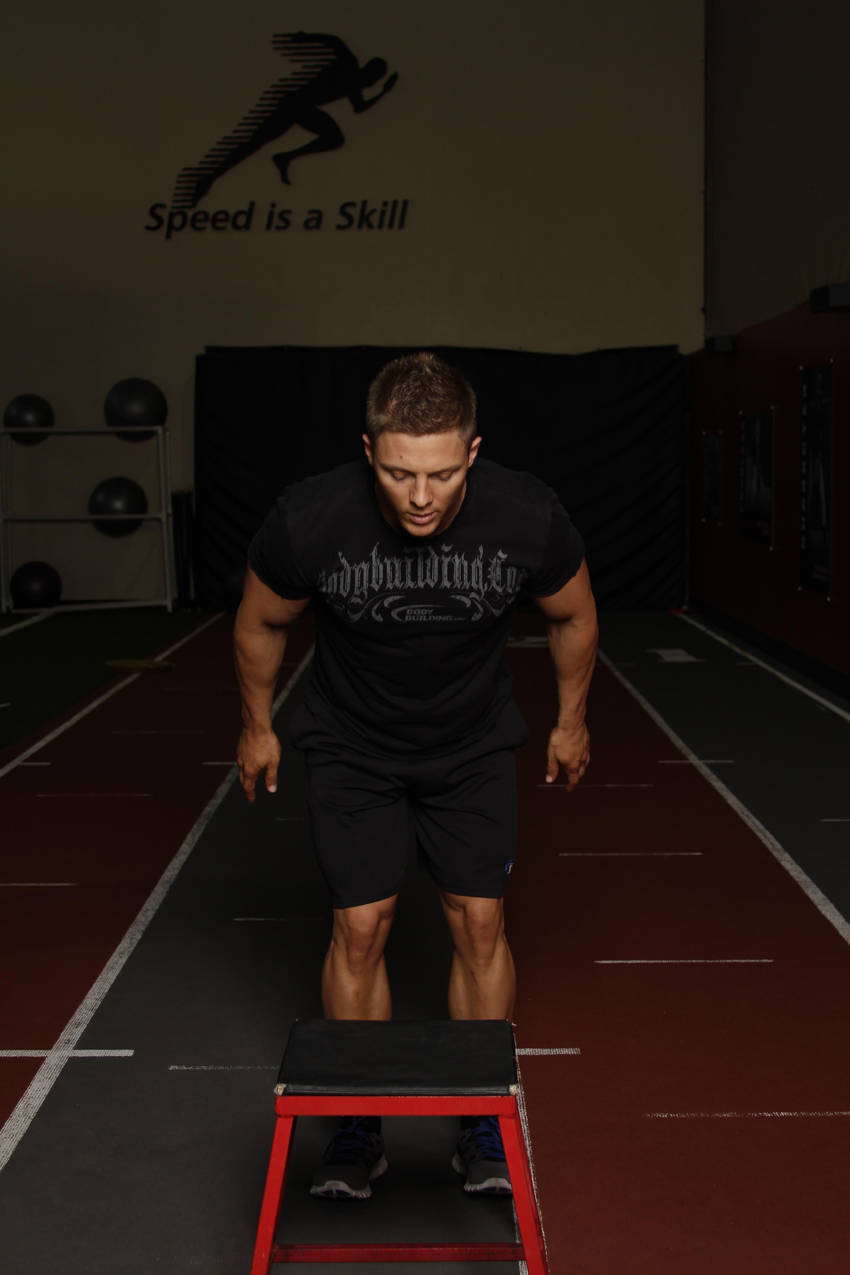
The movement
Form cues
- 01
Stand about an arm's length from the box with feet shoulder-width apart and toes pointed slightly outward.
- 02
Bend your knees slightly and let your arms hang relaxed at your sides before each jump.
- 03
Swing both arms forward and upward as you push off the floor — your arms drive the jump.
- 04
Push through the balls of your feet to launch yourself up and forward onto the box.
- 05
Land with both feet at the same time, toes first, then let your heels settle down gently.
- 06
As you land, bend your knees to absorb the impact — your knees should track over your middle toes, not cave inward.
- 07
Step or jump back down immediately and reset your stance before the next jump.
- 08
Keep your chest up and eyes forward throughout — don't look down at your feet mid-jump.
Dosage
How long, how many
Sets
3
Reps
8-12
Rest
60 sec
Watch for
Common mistakes
Landing with stiff, straight legs — if your knees don't bend on landing, you're sending all the impact into your joints instead of absorbing it through your muscles.
Knees caving inward on landing — glance down after you land; your kneecaps should be pointing the same direction as your second toe, not collapsing toward each other.
Jumping too far forward instead of up — if you're consistently landing near the far edge of the box, shorten your approach and focus on height rather than distance.
Rushing the reset between reps — if your feet aren't fully set before the next jump, you lose the power position and increase the risk of a misstep.
Using a box that's too high — if you have to strain, hesitate, or can't land softly, the box is too tall; start lower and earn your way up.
Scale it
Easier and harder variations
Easier
Use a single low step (4–6 inches) instead of a box, and step up one foot at a time rather than jumping with both feet.
Start here if you haven't done any jumping in years or if you're building confidence with impact.
Easier
Do the jump onto the box but step back down slowly rather than jumping or dropping off — this removes the second impact entirely.
Good when knees or ankles are sensitive to repeated landing forces.
Harder
Increase the box height by 2–4 inches once you can land softly and quietly for all reps — a quiet landing means your muscles are doing their job.
Progress here when the current height feels easy and your landings are consistently controlled.
Note
Replace with seated leg press or standing mini-squats to build the same leg muscles without any jumping impact.
Use this if you have a current knee, ankle, or hip issue that makes landing painful.
Sources
Form descriptions and cues are sourced from wger (CC-BY-SA 4.0) and the Free Exercise DB (public domain), edited for the 60+ audience. MET value cites Ainsworth BE, et al. 2011 Compendium of Physical Activities. Med Sci Sports Exerc 43(8):1575-1581.
- free-exercise-db · Unlicense / Public Domain
- claude