
Cardio · Beginner
Stationary Bicycle
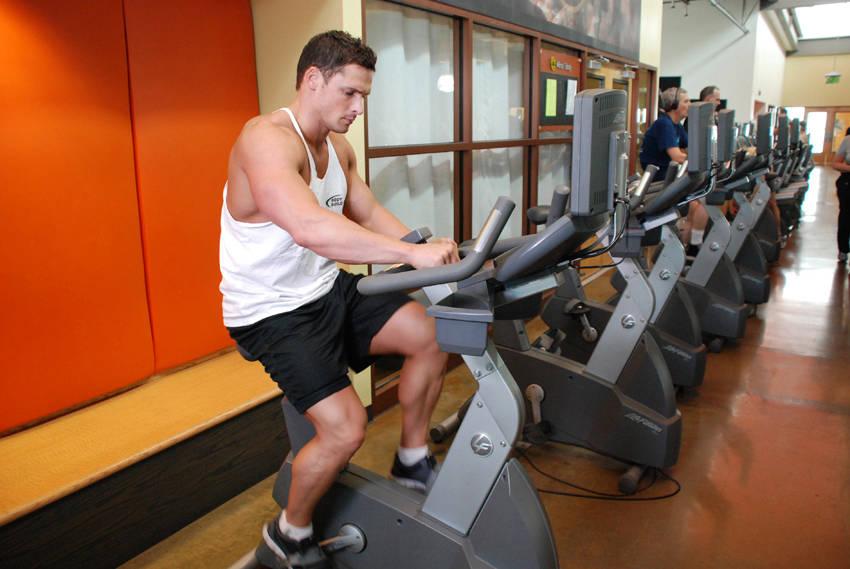
A stationary bike lets you get a solid cardio workout without putting heavy impact on your knees, hips, or ankles. Pedaling builds strength in your thighs, calves, and backside while keeping your heart and lungs working. It's one of the most joint-friendly ways to stay active, and you control the pace and resistance the entire time.
Category
Cardio
Difficulty
Beginner
Equipment
Machine
MET
4.0
Primary muscles
Secondary muscles
The movement
Form cues
- 01
Adjust the seat height so your knee has a slight bend — not fully straight — when the pedal is at its lowest point.
- 02
Sit tall with your back gently upright, not hunched over the handlebars.
- 03
Rest your hands lightly on the handlebars — you're steadying yourself, not holding yourself up.
- 04
Place the ball of your foot over the center of the pedal, not your arch or heel.
- 05
Push down through your heel and mid-foot on the downstroke, then pull back gently at the bottom like you're scraping mud off your shoe.
- 06
Keep your knees tracking forward over your feet — they shouldn't bow out or swing inward as you pedal.
- 07
Breathe steadily; you should be able to speak a short sentence without gasping.
- 08
Start at a low resistance and build gradually — you can always add more once you're warmed up.
Dosage
How long, how many
Sets
1
Reps
20-30 min
Rest
0 sec
Watch for
Common mistakes
Seat set too low — if your knees are coming up toward your chest on each stroke, raise the seat until there's only a slight bend at the bottom of the pedal stroke.
Gripping the handlebars too hard — if your knuckles are white or your shoulders are creeping up toward your ears, loosen your grip and let your shoulders drop.
Pedaling too fast at high resistance — if you're bouncing in the seat or rocking side to side, lower the resistance until you can pedal smoothly.
Hunching forward over the bars — if your upper back feels rounded and tight after a few minutes, sit back and lift your chest slightly.
Skipping the warm-up — jumping straight to a hard effort can strain cold muscles; spend the first three to five minutes at an easy, comfortable pace.
Scale it
Easier and harder variations
Easier
Set resistance to the lowest level and aim for just 5–10 minutes of continuous pedaling, building duration week by week.
If you're just returning to exercise or find your legs fatiguing quickly.
Harder
Increase resistance until pedaling feels like cycling uphill, and hold that effort for 1–2 minute intervals before recovering at an easy pace.
Once 20–30 minutes at moderate resistance feels comfortable.
Note
Use a recumbent stationary bike, which has a seat with a back rest and pedals out in front — this takes pressure off your lower back and is easier on hip flexors.
If you have lower back pain, hip discomfort, or balance concerns that make an upright bike uncomfortable.
Sources
Form descriptions and cues are sourced from wger (CC-BY-SA 4.0) and the Free Exercise DB (public domain), edited for the 60+ audience. MET value cites Ainsworth BE, et al. 2011 Compendium of Physical Activities. Med Sci Sports Exerc 43(8):1575-1581.
- free-exercise-db · Unlicense / Public Domain
- claude