
Cardio · Beginner
Bench Sprint
The bench sprint is a stepping drill where you alternate feet on and off a low bench or step in a quick, rhythmic pattern. It builds leg strength and gets your heart rate up without the impact of running. Because you're always in contact with a surface, it's more controlled than jumping exercises while still training the muscles you need for climbing stairs and moving quickly.
Category
Cardio
Difficulty
Beginner
Equipment
Other
MET
2.8
Primary muscles
Secondary muscles
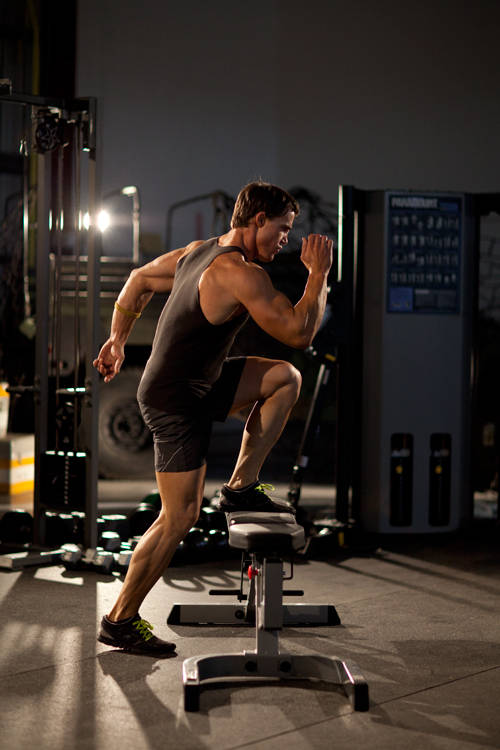
The movement
Form cues
- 01
Stand facing a sturdy bench or step that won't slide — test it before you start.
- 02
Place one foot flat on top of the bench with your heel near the back edge, not dangling off the front.
- 03
Push down through that top foot to drive your body upward, straightening the hip and knee fully.
- 04
As you push up, swing the opposite foot up to land on the bench while the first foot steps back to the floor.
- 05
Land softly with your whole foot, not just your toes, to protect your knees and ankles.
- 06
Keep your chest up and your gaze forward — don't look down at your feet once you find your rhythm.
- 07
Pump your arms naturally as you alternate feet, just like you would walking up stairs quickly.
- 08
Start slow enough that each foot placement feels deliberate, then pick up speed only when you feel steady.
Dosage
How long, how many
Sets
3
Reps
8-12
Rest
60 sec
Watch for
Common mistakes
Placing the foot too close to the edge — if your toes hang off the front, your foot can slip; set your heel near the back edge of the step.
Bending forward at the waist — if your chest is dropping toward your knee, slow down and stand taller before speeding up.
Pushing off the floor foot instead of the bench foot — the leg on top does the work; if your standing leg feels like it's doing all the lifting, reset and focus on pressing through the elevated foot.
Landing with stiff, straight legs — your knee should have a slight bend when your foot touches the bench, not locked out, to absorb the impact.
Going too fast before you're ready — if your foot placements start feeling sloppy or you're clipping the edge, slow back down; speed is earned, not assumed.
Holding your breath — breathe steadily throughout; if you can't, you're moving faster than your fitness currently supports.
Scale it
Easier and harder variations
Easier
Use a single low step (4–6 inches) instead of a bench, and slow the pace to a deliberate walk-up rhythm rather than a sprint.
Use this if you feel unsteady, are new to step exercises, or are working around a knee or hip concern.
Harder
Increase the speed of alternations to a true sprint pace for 20-second bursts, then rest 40 seconds before repeating.
Use this once you can complete a full set with clean foot placement and no stumbles.
Note
If you have knee pain, reduce the bench height to the lowest available step and slow the movement to a controlled step-up and step-down with no speed component.
Use this if you have knee replacement, arthritis flare-ups, or any sharp knee pain during the standard version.
Sources
Form descriptions and cues are sourced from wger (CC-BY-SA 4.0) and the Free Exercise DB (public domain), edited for the 60+ audience. MET value cites Ainsworth BE, et al. 2011 Compendium of Physical Activities. Med Sci Sports Exerc 43(8):1575-1581.
- free-exercise-db · Unlicense / Public Domain
- claude