
Balance · Beginner
Standing Calf Raise
A calf raise strengthens the muscles along the back of your lower leg by lifting your heels off the ground and lowering them back down. Strong calves help you push off when walking, climb stairs with confidence, and keep your balance on uneven ground. This is a simple move you can do almost anywhere, with or without a machine.
Category
Balance
Difficulty
Beginner
Equipment
Bodyweight
MET
3.5
Primary muscles
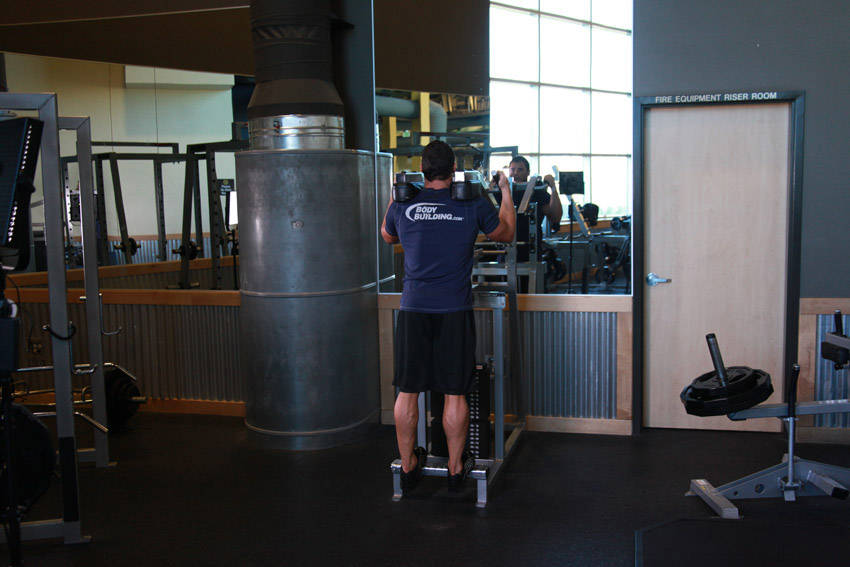
The movement
Form cues
- 01
Stand with your feet hip-width apart and your toes pointing straight ahead or turned very slightly outward.
- 02
Rest your hands lightly on a wall, counter, or chair back — just enough to steady yourself, not to hold yourself up.
- 03
Keep a very slight bend in your knees throughout; never lock them straight.
- 04
Slowly rise up onto the balls of your feet, lifting your heels as high as you comfortably can.
- 05
Pause at the top for a full second — you should feel your calf muscles squeeze tight.
- 06
Lower your heels back down slowly and with control; don't let them drop.
- 07
Breathe out as you rise, breathe in as you lower — keep a steady rhythm.
Dosage
How long, how many
Sets
3
Reps
8-12
Rest
60 sec
Watch for
Common mistakes
Rushing through the movement — if your heels are bouncing up and down quickly, you're losing most of the benefit; slow each rep to a 2-count up and 2-count down.
Gripping the support too hard — if your knuckles are white, you're leaning on it rather than balancing; lighten your grip to just a fingertip touch.
Locking the knees at the top — if your legs feel rigid and straight, soften the knees slightly to protect the joint.
Letting the ankles roll outward — if your weight shifts to the outer edge of your foot at the top, focus on pushing evenly through all five toes.
Not going through a full range of motion — if your heels barely leave the floor, you're shortchanging the stretch; aim to lift as high as your ankle allows and lower until you feel a gentle pull in the calf.
Scale it
Easier and harder variations
Easier
Do the movement seated in a sturdy chair, pressing the balls of your feet into the floor and lifting your heels — this removes the balance challenge entirely.
Use this if standing balance is a concern or you're just getting started.
Harder
Try single-leg calf raises — lift one foot slightly off the floor and perform all reps on one leg at a time, still using a fingertip touch on a support.
Use this once you can complete 3 sets of 12 two-legged raises with good control.
Note
If you have Achilles tendon soreness or plantar fasciitis, limit the range of motion — raise only halfway and skip the deep heel drop below floor level until cleared by your doctor or physical therapist.
Use this if you feel sharp pain or tightness in the heel or bottom of the foot during the movement.
Sources
Form descriptions and cues are sourced from wger (CC-BY-SA 4.0) and the Free Exercise DB (public domain), edited for the 60+ audience. MET value cites Ainsworth BE, et al. 2011 Compendium of Physical Activities. Med Sci Sports Exerc 43(8):1575-1581.
- wger · CC-BY-SA 4.0
- free-exercise-db · Unlicense / Public Domain
- claude