
Balance · Beginner
Standing Cable Lift
The standing cable lift is a diagonal pulling movement that trains your core to resist rotation while your arms sweep from low to high across your body. It mimics real-life motions like lifting a bag from the floor or reaching across to a high shelf. Because you're standing on two feet and controlling a moving cable, your balance and coordination get a workout alongside your midsection. It's a practical strength exercise, not just a gym drill.
Category
Balance
Difficulty
Beginner
Equipment
Cable
MET
2.5
Primary muscles
Secondary muscles
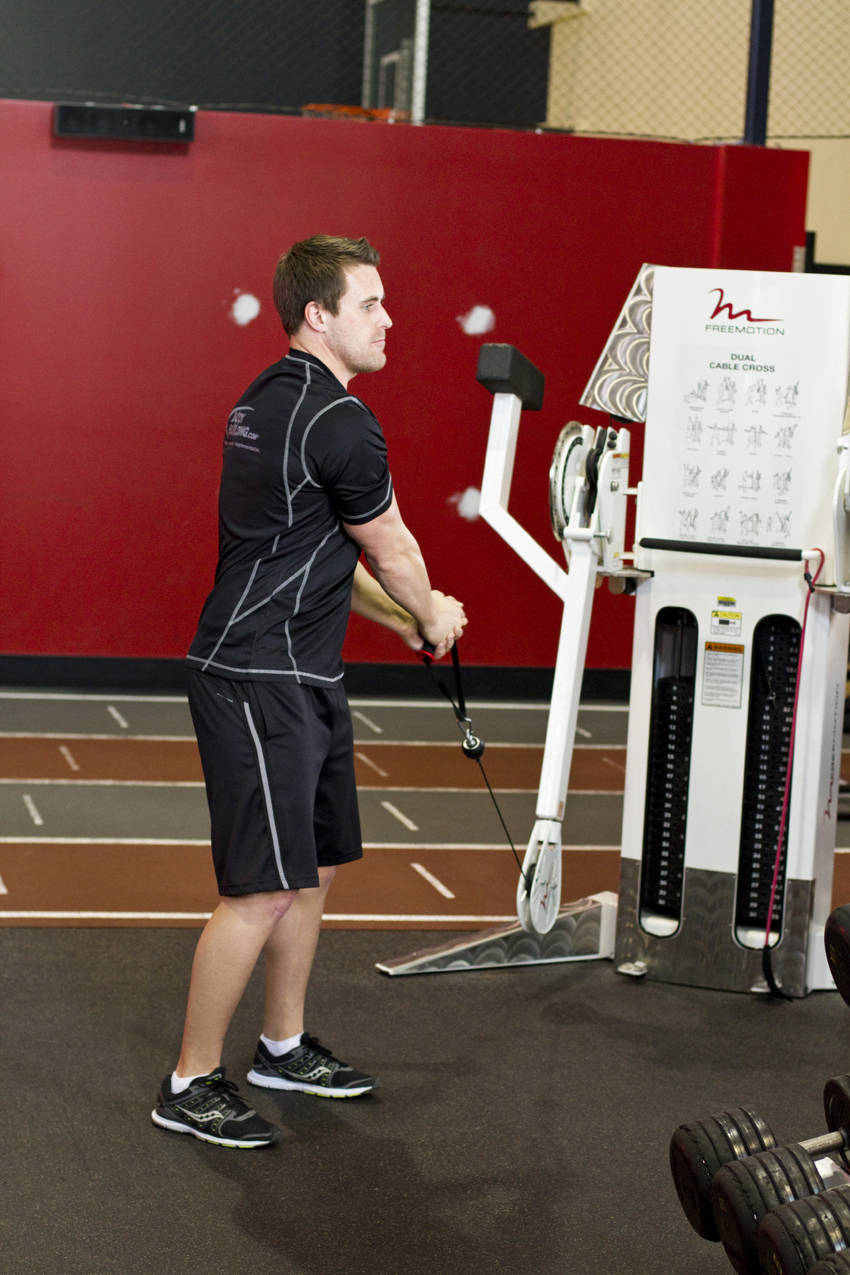
The movement
Form cues
- 01
Stand with your side facing the cable machine, feet shoulder-width apart.
- 02
Bend your knees and hinge slightly at the hips to reach down and grip the handle with both hands, arms fully extended toward the low pulley.
- 03
Before you move, brace your stomach — squeeze your belly muscles like you're bracing for a gentle punch.
- 04
In one smooth motion, pull the handle diagonally up and across your body, finishing with both arms extended above your opposite shoulder.
- 05
Let your back heel lift and your torso rotate naturally as the handle rises — don't lock your hips in place.
- 06
Keep your arms relatively straight throughout; this is a core movement, not a bicep curl.
- 07
Lower the handle back down slowly along the same diagonal path — take at least two full seconds on the way down.
- 08
Stand tall between reps and reset your brace before starting the next one.
Dosage
How long, how many
Sets
3
Reps
8-12
Rest
60 sec
Watch for
Common mistakes
Yanking with the arms instead of leading with the torso — if your elbows are bending a lot, you're turning it into an arm exercise. Keep arms long and let your core do the driving.
Rushing the return — if the cable is snapping back, you're losing the most important part of the exercise. Control the descent as carefully as the lift.
Feet too close to the machine — if the cable is pulling you sideways off balance, step farther out until you feel steady tension before you start.
Holding your breath — if you feel your face tightening or get lightheaded, exhale on the way up and inhale on the way down.
Over-rotating at the top — if your shoulders spin past your hips, you've gone too far. Stop when your arms are above your opposite shoulder and your chest faces the same direction as your feet.
Scale it
Easier and harder variations
Easier
Use a lighter weight and reduce the range of motion — stop the lift at chest height rather than overhead until the movement feels comfortable.
Good starting point if you feel unsteady or if overhead reaching is uncomfortable.
Harder
Perform the lift standing on one foot — the leg on the same side as the cable — to dramatically increase the balance challenge.
Try this once you can complete 12 reps on both sides with full control and no wobbling.
Note
Sit on a sturdy chair or bench positioned sideways to the cable and perform the diagonal pull from seated, stopping at shoulder height. This removes the balance demand and reduces spinal load.
Use this version if you have a knee, hip, or lower-back issue that makes standing rotation painful.
Sources
Form descriptions and cues are sourced from wger (CC-BY-SA 4.0) and the Free Exercise DB (public domain), edited for the 60+ audience. MET value cites Ainsworth BE, et al. 2011 Compendium of Physical Activities. Med Sci Sports Exerc 43(8):1575-1581.
- free-exercise-db · Unlicense / Public Domain
- claude