
Balance · Beginner
Standing Bent-Over Two-Arm Dumbbell Triceps Extension
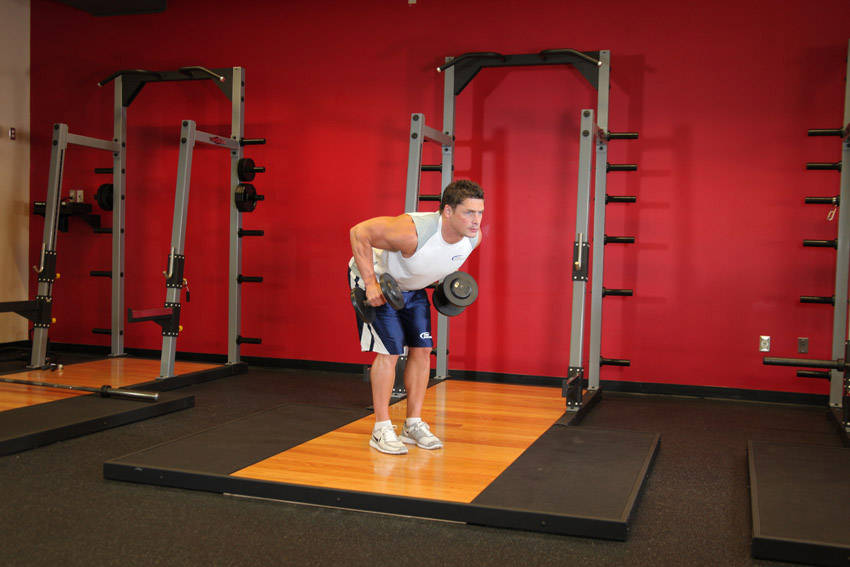
You hold a dumbbell in each hand, hinge forward at the waist, and then straighten both arms behind you — working the triceps, the muscles along the back of your upper arms. Strong triceps make pushing movements easier, from getting up off the floor to closing a heavy door. This version uses both arms at once, which keeps the movement efficient and helps you build balanced strength on both sides.
Category
Balance
Difficulty
Beginner
Equipment
Dumbbell
MET
2.5
Primary muscles
The movement
Form cues
- 01
Stand with feet shoulder-width apart, holding a light dumbbell in each hand with palms facing each other.
- 02
Soften your knees slightly — a small bend, not a deep squat.
- 03
Hinge forward at your hips until your back is roughly parallel to the floor, like you're about to pick something up off a low table.
- 04
Keep your back flat and your head in line with your spine — look at the floor a foot or two ahead of you, not straight down.
- 05
Pin your upper arms against your sides so they stay parallel to the floor throughout the movement — only your forearms should move.
- 06
Breathe out as you straighten both arms fully behind you, squeezing the backs of your upper arms at the top.
- 07
Hold that squeeze for one full second before lowering.
- 08
Breathe in as you slowly bend your elbows back to 90 degrees to return to the start — don't let the weights drop.
Dosage
How long, how many
Sets
3
Reps
8-12
Rest
60 sec
Watch for
Common mistakes
Letting the upper arms drop — if your elbows drift toward the floor during the movement, you've lost the position; reset by lifting them back level with your torso before continuing.
Swinging the weights up with momentum — if you feel a jerk or a lurch at the start of each rep, you're going too heavy; slow down and use a lighter dumbbell.
Rounding the back — if your shoulders are curling toward the floor, you've bent too far forward or the weight is too heavy; reduce the range of hinge until your back stays flat.
Holding your breath — if you feel your face getting red or tense, you're forgetting to breathe; exhale on the push, inhale on the return.
Locking the elbows aggressively at the top — a firm straightening is enough; snapping them into a hard lock puts unnecessary stress on the joint.
Scale it
Easier and harder variations
Easier
Use one arm at a time and rest your free hand on a chair or countertop for balance and back support.
If holding the bent-over position feels unsteady or strains your lower back.
Harder
Pause for three full seconds at the top of each rep with arms fully extended before lowering.
When the standard tempo feels too easy and you want more challenge without adding weight.
Note
Sit on the edge of a firm chair, lean your torso forward onto your thighs, and do the extension from there — same arm movement, far less demand on your lower back.
If you have lower back pain or discomfort that makes the standing hinge position uncomfortable.
Sources
Form descriptions and cues are sourced from wger (CC-BY-SA 4.0) and the Free Exercise DB (public domain), edited for the 60+ audience. MET value cites Ainsworth BE, et al. 2011 Compendium of Physical Activities. Med Sci Sports Exerc 43(8):1575-1581.
- free-exercise-db · Unlicense / Public Domain
- claude