
Balance · Beginner
Standing Bent-Over One-Arm Dumbbell Triceps Extension
This exercise works the triceps — the muscles along the back of your upper arm — by straightening your elbow against resistance while your torso is hinged forward. Strong triceps make pushing motions easier, whether you're getting up from a chair, pushing open a heavy door, or lifting yourself off the floor. It's a simple, focused movement that requires only one dumbbell and a little floor space.
Category
Balance
Difficulty
Beginner
Equipment
Dumbbell
MET
2.5
Primary muscles
Secondary muscles
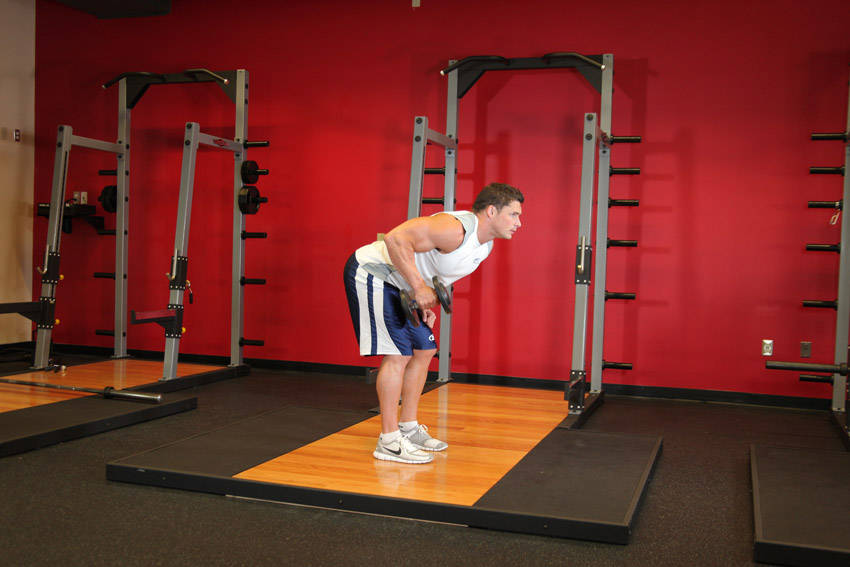
The movement
Form cues
- 01
Stand with feet hip-width apart, dumbbell in one hand, palm facing your body.
- 02
Bend your knees slightly — just enough so they're not locked — then hinge forward at your hips until your back is nearly flat, like a tabletop.
- 03
Keep your chin slightly lifted so your neck stays in line with your spine, not drooping toward the floor.
- 04
Pin your working upper arm against your side so it runs parallel to the floor — this is your anchor point and it should not move.
- 05
Your forearm should hang straight down from the elbow, forming a right angle with your upper arm before you begin.
- 06
Breathe out as you slowly straighten your elbow, sweeping the dumbbell back and up until your whole arm is level and fully extended.
- 07
Hold for one full second at the top — you should feel a firm squeeze in the back of your upper arm.
- 08
Breathe in as you slowly lower the dumbbell back to the starting right-angle position, controlling the weight the whole way down.
- 09
Complete all reps on one side before switching arms.
Dosage
How long, how many
Sets
3
Reps
8-12
Rest
60 sec
Watch for
Common mistakes
Swinging the upper arm up and down — if your elbow is moving, you're using momentum instead of your triceps; keep the upper arm pinned and still.
Letting the back round like a hump — if you feel strain in your lower back, re-hinge from the hips and think about making your back flat enough to balance a glass of water on it.
Rushing through the lowering phase — if the dumbbell drops quickly on the way down, slow it to a 2-count; that's where a lot of the muscle-building happens.
Choosing too heavy a weight — if your elbow drifts or your torso twists to finish the rep, the dumbbell is too heavy; drop down a size.
Locking the standing knee — a fully locked knee puts stress on the joint; keep a soft, slight bend throughout the set.
Scale it
Easier and harder variations
Easier
Rest your free hand on a sturdy chair or countertop for support, so you can focus entirely on the arm movement without worrying about balance.
Use this if holding the bent-over position feels unsteady or strains your lower back.
Harder
Pause for a full 3-count squeeze at the top of each rep before lowering, keeping the arm fully extended the entire hold.
Use this once 12 reps feel easy and you want more challenge without adding weight.
Note
Sit on the edge of a firm chair, lean forward from the hips with your back flat, and brace your non-working forearm on your thigh — then perform the same triceps extension motion with a very light dumbbell.
Use this if standing or hinging forward aggravates your lower back, hips, or knees.
Sources
Form descriptions and cues are sourced from wger (CC-BY-SA 4.0) and the Free Exercise DB (public domain), edited for the 60+ audience. MET value cites Ainsworth BE, et al. 2011 Compendium of Physical Activities. Med Sci Sports Exerc 43(8):1575-1581.
- free-exercise-db · Unlicense / Public Domain
- claude