
Balance · Beginner
Smith Machine Single-Leg Split Squat
This exercise has you lowering one leg at a time while the other foot rests on a bench behind you, all with a barbell supported by the Smith machine's guided track. That fixed bar path gives you extra stability so you can focus on building leg strength without worrying about balance. It targets the front of your thigh while also working your glutes and hamstrings, and the single-leg nature helps even out any strength differences between your two sides — something that matters a lot for everyday movement and fall prevention.
Category
Balance
Difficulty
Beginner
Equipment
Machine
MET
2.5
Primary muscles
Secondary muscles
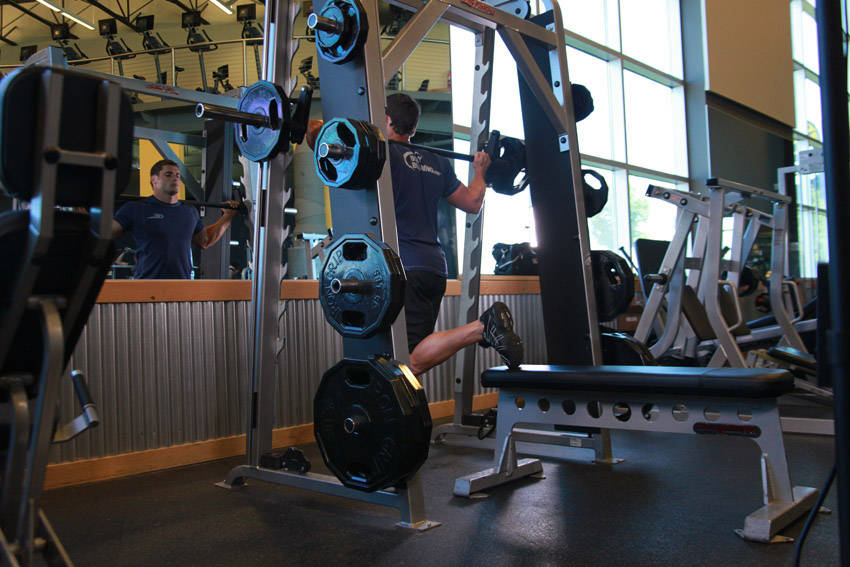
The movement
Form cues
- 01
Set the bar at about shoulder height, step under it, and rest it across the back of your shoulders — not on your neck.
- 02
Place a flat bench 2 to 3 feet directly behind you before you unrack the bar.
- 03
Step one foot forward so it sits roughly under the bar, then reach back and rest the top of your other foot on the bench.
- 04
Stand tall with your chest up and eyes looking straight ahead before you begin to lower.
- 05
Bend your front knee slowly, lowering your back knee toward the floor — stop when your front thigh is roughly parallel to the floor.
- 06
Check that your front knee stays directly over your foot and does not drift past your toes — if it does, shift your front foot a few inches forward.
- 07
Push through the heel of your front foot to drive yourself back up, straightening your leg fully at the top.
- 08
Breathe in as you lower down and breathe out as you push back up.
- 09
Complete all reps on one side before switching legs.
Dosage
How long, how many
Sets
3
Reps
8-12
Rest
60 sec
Watch for
Common mistakes
Front knee drifting past the toes — if you look down and can't see your front foot, shift that foot further forward before your next rep.
Leaning too far forward at the torso — if your chest is nearly over your knee, brace your stomach and lift your chin to bring your upper body upright.
Back foot placed flat on the bench instead of top-of-foot down — this strains the ankle and throws off your balance; curl the toes under so the top of the foot rests on the bench.
Dropping too fast on the way down — if you feel a thud in your back knee, slow the lowering phase to a 2-3 second count.
Letting the front knee cave inward — if your knee rolls toward the center, actively push it outward so it tracks over your second toe.
Not going low enough to get benefit — if your front thigh never reaches parallel, check that the bench is close enough and lower with control until you feel a stretch in the back hip.
Scale it
Easier and harder variations
Easier
Rest your back foot on a low step or thick book instead of a full-height bench to reduce the range of motion and make balance easier.
Use this when the full bench height feels unstable or causes discomfort in the back hip or knee.
Harder
Add a slow 3-second lowering phase on every rep to increase time under tension and make the muscles work harder without adding weight.
Use this once 3 sets of 12 reps feel manageable and you want more challenge before increasing the bar weight.
Note
If you have knee discomfort, limit your range of motion to a shallow dip — lower only until you feel mild tension, not pain — and keep the front shin as vertical as possible.
Use this with knee arthritis or after knee replacement; check with your doctor or physical therapist before loading the movement.
Sources
Form descriptions and cues are sourced from wger (CC-BY-SA 4.0) and the Free Exercise DB (public domain), edited for the 60+ audience. MET value cites Ainsworth BE, et al. 2011 Compendium of Physical Activities. Med Sci Sports Exerc 43(8):1575-1581.
- free-exercise-db · Unlicense / Public Domain
- claude