
Balance · Beginner
Single Leg Glute Bridge
You lie on your back, lift one foot off the floor, and push your hips toward the ceiling using only the planted leg. This challenges your glutes and hamstrings one side at a time, which helps correct strength imbalances that can cause hip and knee problems. It also trains the stability muscles around your pelvis — the ones that keep you steady when you're walking, climbing stairs, or stepping off a curb.
Category
Balance
Difficulty
Beginner
Equipment
Bodyweight
MET
2.5
Primary muscles
Secondary muscles
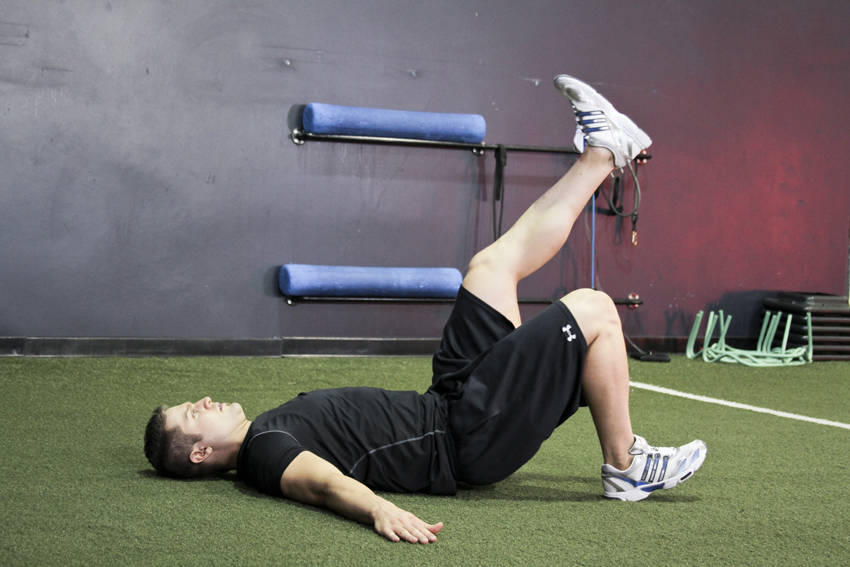
The movement
Form cues
- 01
Lie on your back with both knees bent and feet flat on the floor, about hip-width apart.
- 02
Lift one knee toward your chest and hold it there — this leg stays in the air the whole set.
- 03
Press your lower back gently into the floor before you start, so your spine is neutral, not arched.
- 04
Push through the heel of your planted foot — not the ball of your foot — to lift your hips.
- 05
Raise your hips until your body forms a straight line from your shoulder to your knee; stop there.
- 06
Squeeze your glute at the top like you're trying to hold a folded towel between your cheek and the back of your thigh.
- 07
Hold the top position for one full second before lowering slowly — don't just drop.
- 08
Keep your hips level throughout; neither side should dip or twist toward the floor.
Dosage
How long, how many
Sets
3
Reps
8-12
Rest
60 sec
Watch for
Common mistakes
Pushing off the ball of the foot instead of the heel — if your toes are doing the work, your calf is compensating and your glute isn't firing properly. Lift your toes slightly off the floor to force the heel to drive.
Hips tilting to one side — if the hip of your raised leg sags lower than the planted side, your glute isn't strong enough yet to stabilize. Drop the range of motion until you can keep both hip bones level.
Arching the lower back at the top — if your ribs flare up and your stomach pokes toward the ceiling, you've gone too high. Lower your hips until your back feels flat and your abs are lightly engaged.
Rushing through reps — bouncing up and down removes the muscle work. Slow the lowering phase to two counts so the glute stays under tension.
Letting the planted knee drift inward — if your knee falls toward the centerline, push it back out so it stays directly above your second toe.
Scale it
Easier and harder variations
Easier
Do a standard two-leg glute bridge first: keep both feet on the floor and lift with both legs until you can hold the top position steadily for 10 reps before attempting the single-leg version.
Use this if lifting one leg causes your hips to immediately tilt or you feel unstable.
Harder
Place your planted foot on a low, stable step or a folded yoga mat to increase the range of motion, so your hips dip below the level of your foot at the bottom of each rep.
Use this once 12 reps feel easy and you can hold the top position without any hip tilt.
Note
If you have knee discomfort, keep the raised knee bent at 90 degrees and hug it lightly with both hands rather than pulling it toward your chest — this reduces hip flexor tension and takes stress off the knee joint.
Use this if straightening or pulling the raised leg causes knee or hip pain.
Sources
Form descriptions and cues are sourced from wger (CC-BY-SA 4.0) and the Free Exercise DB (public domain), edited for the 60+ audience. MET value cites Ainsworth BE, et al. 2011 Compendium of Physical Activities. Med Sci Sports Exerc 43(8):1575-1581.
- free-exercise-db · Unlicense / Public Domain
- claude