
Balance · Beginner
Dumbbell Seated One-Leg Calf Raise
This exercise strengthens the calf muscles one leg at a time while you're safely seated, so balance isn't a factor. Strong calves help push you up from a chair, climb stairs, and keep you steady on uneven ground. The slight elevation under your foot lets you get a fuller range of motion than a flat floor allows. Adding a dumbbell on your thigh gives the muscle enough resistance to actually grow stronger over time.
Category
Balance
Difficulty
Beginner
Equipment
Dumbbell
MET
2.5
Primary muscles
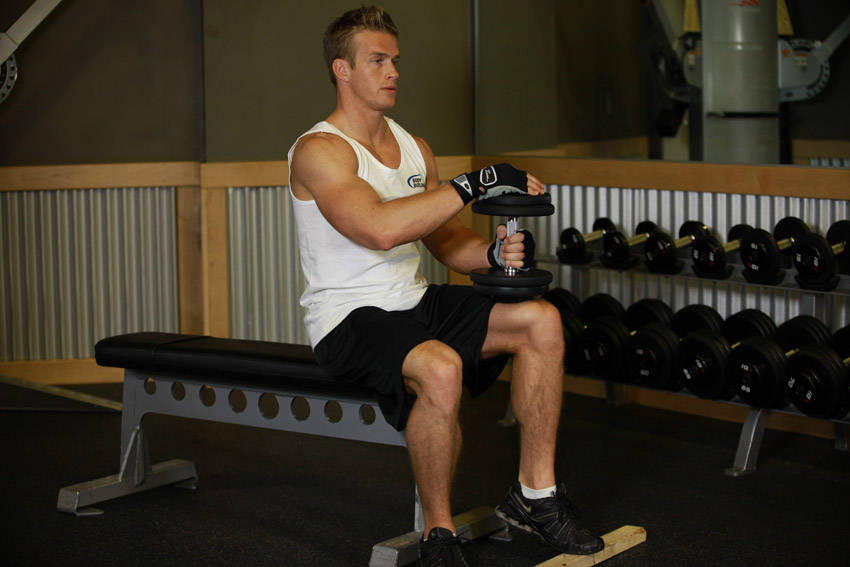
The movement
Form cues
- 01
Sit tall on the bench with your back away from any backrest — no slouching.
- 02
Place the dumbbell on your upper thigh, about three inches above your knee, and hold it steady with one hand.
- 03
Set the ball of your foot on the edge of the block so your heel hangs freely below it.
- 04
Let your heel drop as low as it comfortably goes before you start — this is your full stretch position.
- 05
Press through the ball of your foot and raise your heel as high as you can, like you're trying to stand on your tiptoes.
- 06
Hold the top position for a full second — you should feel your calf squeeze tight.
- 07
Lower your heel slowly, taking about two seconds, and let it drop below the block again before the next rep.
- 08
Keep your working knee pointing straight ahead throughout — don't let it drift in or out.
Dosage
How long, how many
Sets
3
Reps
8-12
Rest
60 sec
Watch for
Common mistakes
Bouncing through the reps — if your heel barely drops before shooting back up, you're losing the stretch and cheating the muscle. Pause at the bottom.
Placing the dumbbell too close to the knee — if it's right on the kneecap, shift it three inches up the thigh to avoid discomfort.
Rushing the lowering phase — if the movement takes less than a second going down, slow it to a two-count. The slow drop is where a lot of the strength gain happens.
Letting the ankle roll outward at the top — if your pinky-toe side lifts higher than your big-toe side, you're not getting full calf activation. Push evenly through the whole ball of your foot.
Using a dumbbell that's too heavy — if you can't hold the weight steady on your thigh or your reps drop below eight, go lighter.
Scale it
Easier and harder variations
Easier
Skip the block and do the raise flat on the floor — you'll lose some range of motion but the movement is still effective while you build strength.
Use this if you don't have a block handy or if the hanging heel position causes discomfort.
Harder
Hold the top position for three full seconds instead of one before lowering — this increases the time your calf is under tension without adding more weight.
Try this once you can complete three sets of 12 reps with good form.
Note
If your Achilles or ankle is sensitive, skip the block entirely and do the raise on a flat surface, limiting how far you lower your heel — just go to neutral rather than below the floor level.
Use this during Achilles tendon flare-ups or after ankle sprains, and check with your doctor or physical therapist before progressing to the elevated version.
Sources
Form descriptions and cues are sourced from wger (CC-BY-SA 4.0) and the Free Exercise DB (public domain), edited for the 60+ audience. MET value cites Ainsworth BE, et al. 2011 Compendium of Physical Activities. Med Sci Sports Exerc 43(8):1575-1581.
- free-exercise-db · Unlicense / Public Domain
- claude