
Balance · Beginner
Balance Board
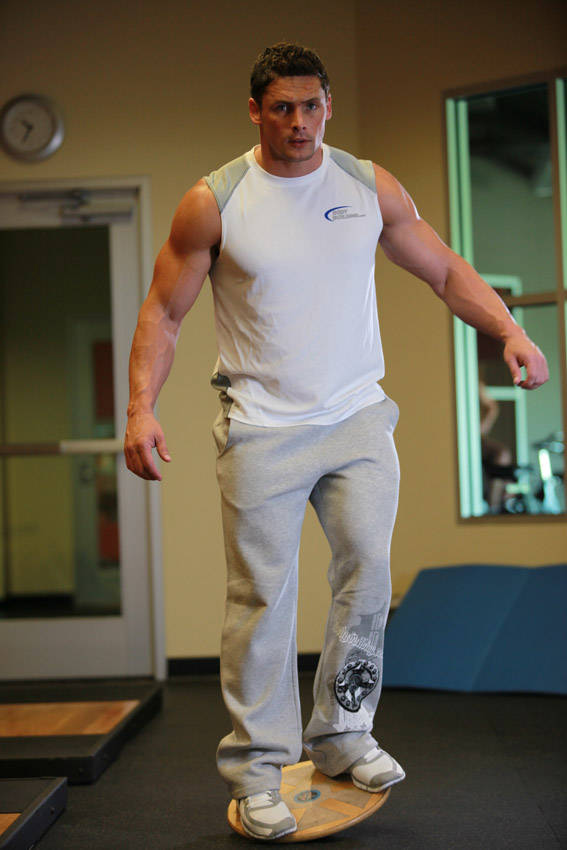
A balance board is a rounded or tilting platform you stand on while trying to keep it level. The constant small adjustments your feet and legs make to stay upright train the stabilizing muscles in your ankles, calves, and knees — the same muscles that catch you when you stumble. Regular practice builds the kind of reflexive balance that helps prevent falls in everyday life.
Category
Balance
Difficulty
Beginner
Equipment
Other
MET
2.5
Primary muscles
Secondary muscles
The movement
Form cues
- 01
Place the board on a non-slip surface and stand directly beside a wall or sturdy chair before stepping on.
- 02
Step onto the center of the board one foot at a time, feet about hip-width apart.
- 03
Keep your knees soft — a slight bend, not locked straight and not deeply bent.
- 04
Look straight ahead at a fixed point on the wall rather than down at your feet.
- 05
Let your ankles do the work — small, quick adjustments to keep the board's edges off the floor.
- 06
Keep your arms relaxed at your sides or lightly resting on a support until you feel steady.
- 07
Breathe normally throughout — holding your breath tightens everything and makes balance harder.
Dosage
How long, how many
Sets
3
Reps
30-second holds
Rest
60 sec
Watch for
Common mistakes
Gripping the floor with your toes — if your toes are curling hard, consciously relax them so your whole foot stays flat on the board.
Locking your knees straight — if your legs feel rigid and the board tips sharply, bend your knees just a little to let your joints absorb the movement.
Staring down at the board — if you notice your chin is tucked to your chest, lift your gaze back to eye level on the wall.
Holding your breath — if you feel your chest tighten or your shoulders creep toward your ears, exhale slowly and let your shoulders drop.
Standing too long without support nearby — if you feel yourself tipping beyond a small wobble, reach for the wall immediately rather than fighting a big fall.
Scale it
Easier and harder variations
Easier
Keep one hand lightly resting on the back of a sturdy chair or touching a wall the entire time, removing it only when you feel fully confident.
Use this when you're new to the board or on days when your balance feels off.
Harder
Once steady, slowly turn your head side to side or close your eyes for a few seconds to challenge your balance system further.
Try this after you can hold the board level for 30 seconds without touching a support.
Note
If you have an ankle or knee replacement, skip the board and practice single-leg standing on flat ground with a chair nearby — get clearance from your doctor or physical therapist before using a balance board.
Use this substitute if you have a recent joint replacement or acute ankle injury.
Sources
Form descriptions and cues are sourced from wger (CC-BY-SA 4.0) and the Free Exercise DB (public domain), edited for the 60+ audience. MET value cites Ainsworth BE, et al. 2011 Compendium of Physical Activities. Med Sci Sports Exerc 43(8):1575-1581.
- free-exercise-db · Unlicense / Public Domain
- claude