
Okinawan · Okinawa · breakfast
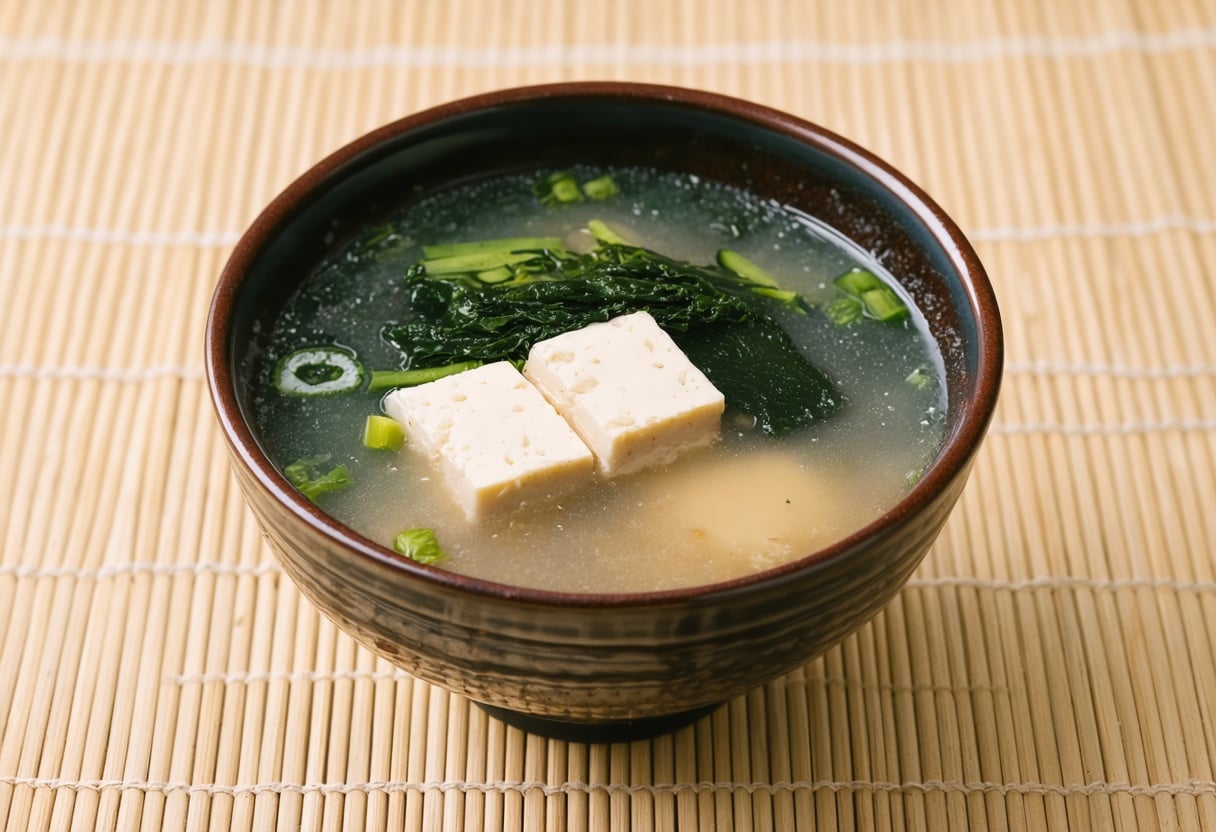
Daily Miso Soup with Tofu and Wakame
豆腐とわかめの味噌汁
In pre-war Okinawa this bowl appeared at breakfast, lunch, and dinner — not as a starter but as the warm, savory backbone of every meal. Authentic dashi is made from kombu and bonito flakes; this version uses instant dashi powder (Hondashi) for everyday supermarket accessibility, which is itself a common shortcut in modern Japanese home kitchens, though scratch dashi delivers a cleaner, more layered depth. The miso goes in last, off the heat, so the live culture stays intact. Simple enough to make every morning once you know the rhythm.
Scan to log · 82 kcal · 9g protein
Point a phone camera at the code to open this recipe — or scan it from a printout to drop today's serving straight into your food log.
Add to today's log →Prep
10 min
Cook
15 min
Rest
5 min
Total
30 min
Servings
4
Difficulty
Easy
What you need
Ingredients
cold water
4 1/2 cups
1080 ml
instant dashi powder (Hondashi or similar)
2 tsp
8 g
Substitution · accessibility
Original: dried kombu (kelp) + bonito flakes (katsuobushi). Authentic ichiban-dashi is made by cold-soaking a 4-inch piece of kombu, warming it to 140–150°F, removing it, then steeping 10 g of bonito flakes for 1 minute off heat and straining. That scratch dashi has a cleaner, more layered umami than instant powder. Hondashi (by Ajinomoto) is sold in the Asian foods aisle at Walmart, Kroger, Safeway, Publix, Wegmans, HEB, Albertsons, Whole Foods, and Trader Joe's — it is a reliable everyday shortcut and is itself widely used in Japanese home kitchens. If you can find kombu and bonito flakes at an Asian grocery or online, follow the original steps 1–3 instead and omit the instant powder entirely. For a fully vegetarian version, use a vegetarian dashi powder (e.g., Shimaya Kombu Dashi) if available, or simmer 4 dried shiitake mushrooms in the water for 20 minutes and strain.
dried wakame seaweed
2 tbsp
6 g
Substitution · accessibility
Original: dried wakame. Dried wakame is stocked in the Asian foods or international aisle at Whole Foods, Trader Joe's, Wegmans, and many Walmart and Kroger locations. It is the correct ingredient here and worth seeking out — no true substitute exists. If genuinely unavailable, dried hijiki (also traditional in Okinawa) can be used: soak 10 minutes, drain, and use the same quantity, though the flavor and texture differ noticeably.
extra-firm tofu
7 oz
200 g
Substitution · authenticity-note
Original: Okinawan shima-dofu (island tofu). Shima-dofu is denser and saltier than standard Japanese tofu; extra-firm tofu pressed for 15 minutes is the closest widely available substitute — do not use silken tofu, it will fall apart.
white miso paste (shiro miso) or awase miso
3 tbsp
54 g
scallions, thinly sliced (green parts only)
2 stalks
20 g
How to cook it
Steps
- 01
4 min
MAKE THE DASHI BASE: Pour the cold water into a medium saucepan. Whisk in the instant dashi powder until fully dissolved. Set the pan over medium heat and bring to a gentle simmer. (If you have access to kombu and bonito flakes, see the substitution note on the dashi powder ingredient and follow the original cold-start kombu method instead — the flavor will be noticeably cleaner and more complex.)
- 02
5 min
REHYDRATE THE WAKAME (runs parallel to step 1): While the dashi heats, place the dried wakame in a small bowl and cover with cold water. It will expand to 4–5 times its dry volume in about 5 minutes. Drain, gently squeeze out excess water, and roughly chop any very large pieces. Set aside.
- 03
3 min
CUT THE TOFU: Drain the tofu and pat it dry with a paper towel. Cut it into 1/2-inch (1.25 cm) cubes — small enough to fit on a soup spoon. If you have time, press the block between two plates with a heavy can on top for 10–15 minutes before cutting; this firms it up and helps it hold its shape in the bowl.
- 04
2 min
ADD TOFU AND WAKAME: Once the dashi reaches a gentle simmer, add the tofu cubes and wakame. Warm through for 2 minutes — you just want everything at serving temperature, not cooking the tofu further.
- 05
2 min
WHISK IN THE MISO — OFF HEAT: This step is non-negotiable for flavor and for preserving the live culture. Remove the pan completely from the heat. Place the miso paste in a small ladle or a separate small bowl. Spoon a ladleful of the hot dashi over the miso and stir until it dissolves into a smooth slurry — no lumps. Pour the slurry back into the pot and stir gently to combine. Never return the soup to a boil after the miso goes in.
- 06
1 min
SERVE IMMEDIATELY: Ladle the soup into four bowls. Scatter sliced scallion greens over each bowl. Drink it while it's hot. In Okinawan tradition this soup is not a side — it is the meal's anchor. Serve alongside a bowl of steamed purple sweet potato or rice if you like, but the soup stands on its own at breakfast.
Chef notes
Notes & variations
Miso varies significantly in saltiness and intensity by brand and type. White (shiro) miso is mild and slightly sweet — a good starting point. Awase miso (a blend of white and red) is more savory and closer to what Okinawan households typically used. Start with 2 1/2 tablespoons if you're new to miso soup and taste before adding the last half tablespoon.
This version uses instant dashi powder (Hondashi) in place of scratch kombu-and-bonito dashi for everyday accessibility. The soup is still deeply satisfying, but scratch dashi has a cleaner, more layered umami. If you make this regularly and want to level up, seek out dried kombu and bonito flakes at an Asian grocery or online — the technique is simple and the difference is real.
Leftover dashi base (before miso is added) keeps refrigerated for up to 3 days. Make a double batch and store it; the next morning's soup takes under 5 minutes.
Okinawan cooks did not measure miso precisely — they used a soup ladle and tasted. Once you've made this a few times, you'll stop measuring too.
For a more complete traditional Okinawan breakfast, add a small side of simmered hijiki with carrot, or a piece of steamed beni-imo (purple sweet potato — red garnet yam is the closest US substitute).
Per serving
Nutrition
Calories
82
Protein
8.5 g
Carbs
5.4 g
Fat
3.5 g
Fiber
1.5 g
Sugars
2 g
Sat fat
0.6 g
Sodium
537 mg
Minerals & vitamins
Potassium
147 mg
Calcium
163 mg
Iron
1.5 mg
Magnesium
30 mg
Vit D
0 IU
Vit B12
0 mcg
Cholesterol
2 mg
- · LLM tiebreak failed for "dried kombu" — picked first result as fallback
Storage
How long it keeps
Fridge
4 days
Freezer
3 months
Room temp
2 hours
Reheating · Reheat to a full boil for 1 minute. Often better on day 2.
Source: foodkeeper
Real products
Where to buy
Real grocery products surfaced via Open Food Facts. Click a product to see its OFF page (ingredients, allergens, Nutri-Score breakdown).
cold water
dried kombu (kelp)
white miso paste (shiro miso) or awase miso
scallions, thinly sliced (green parts only)


